
Comparative Juxtaposition: The Trigger That Makes the Difference Obvious
STUDY LEARNINGS

Cross-platform storytelling is a beloved subject in the second semester, taught by Professor Chris Hofbauer. During the course, Hofbauer introduced us to a variety of storytelling triggers that help capture audience attention and communicate messages effectively across different media and platforms. One of the triggers explored in this article is Comparative Juxtaposition.
Comparative juxtaposition is the act of placing two contrasting elements side by side to highlight their differences and reveal a meaningful relationship between them. The technique is widely used in literature, advertising, and the visual arts because it allows audiences to quickly recognize contrasts and draw conclusions for themselves. By making differences immediately visible, comparative juxtaposition helps storytellers communicate complex ideas in a simple, memorable, and often emotionally engaging way.
Four Questions from Kribbeln im Kopf
Mario Pricken, author of Kribbeln im Kopf, explores this trigger through four practical questions that storytellers can use to shape narratives based on comparative juxtaposition:
What before-and-after comparison could underline the benefit?
What comparison makes the benefit obvious at a glance?
What juxtaposition represents the problem and solution in surprising or humorous terms?
How can the benefit be communicated by comparing it to a completely unrelated context?
These questions serve as valuable tools during the brainstorming and ideation process. Rather than simply presenting facts, they encourage storytellers to search for contrasts that make a message instantly understandable and memorable. In cross-platform storytelling, this approach can help shape narratives that adapt across different media while maintaining a clear core message. For marketers, these questions also open opportunities to present products, services, or ideas from unexpected perspectives, creating stronger audience engagement and making key benefits easier to understand.
Comparative Juxtaposition in Practice
The Buenos Aires Zoo advertisement provides an excellent example of comparative juxtaposition in action. The ad places a plush toy polar bear priced at $28 next to a real polar bear experience at the zoo priced at only $7. At first glance, the audience immediately notices the contrast between the two prices, but the deeper message goes beyond cost alone.
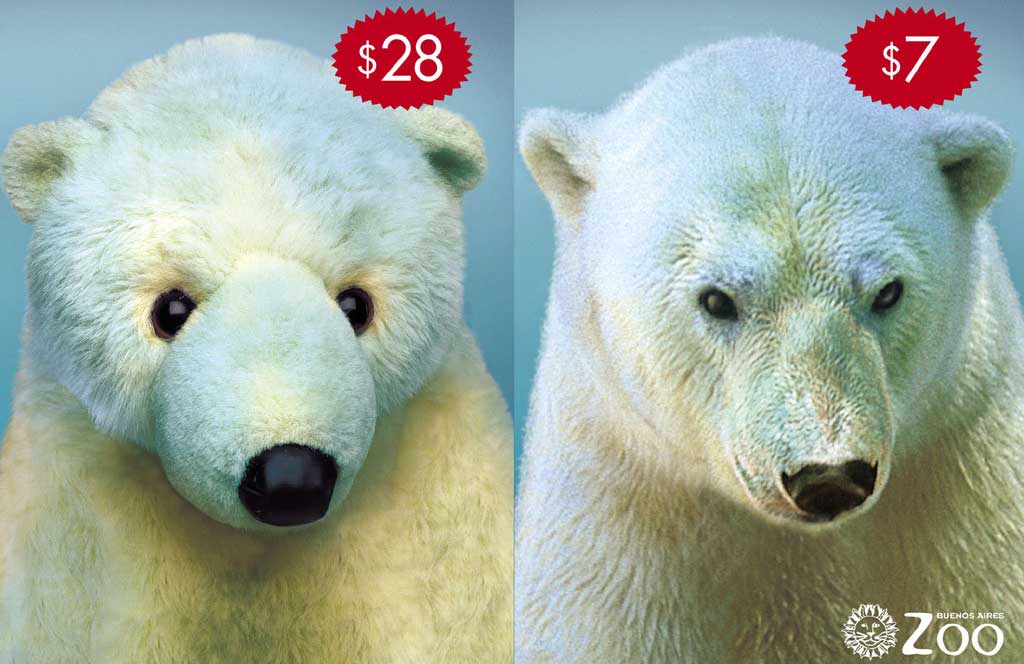
Buenos Aires Zoo advertisement using comparative juxtaposition
The comparison highlights the difference between owning an object and experiencing something meaningful. While the toy is more expensive, it offers only a representation of the animal. A visit to the zoo, on the other hand, provides the opportunity to see a real polar bear and create a memorable experience for a significantly lower price. The visual layout strengthens the message by presenting both options side by side, allowing viewers to make the comparison instantly without requiring lengthy explanations.
What makes this advertisement particularly effective is its use of an unexpected comparison. Most people would not naturally compare a stuffed toy with a zoo visit, yet the juxtaposition reveals a compelling insight: experiences can offer greater value than possessions. By making the contrast obvious at a glance, the advertisement communicates its message quickly, memorably, and with a touch of humor—demonstrating exactly how comparative juxtaposition can be used to strengthen storytelling.
Conclusion
Comparative juxtaposition is a powerful storytelling trigger because it helps audiences understand a message through contrast rather than explanation. By placing two elements side by side, storytellers can make benefits, problems, solutions, and values immediately visible. As Pricken's questions demonstrate, effective storytelling often comes from finding unexpected comparisons that reveal a deeper truth. Whether used in advertising, presentations, or cross-platform campaigns, comparative juxtaposition encourages audiences to think, compare, and arrive at conclusions on their own. This not only makes stories more memorable but also increases their ability to communicate a message clearly across different platforms and contexts.